Latest Articles

- Details
- Projects
imrussia.org
- Details
Since 2011, the Institute of Modern Russia has been developing its analytical online publication imrussia.org, featuring original, high-quality content in both English and Russian. The goal of the publication is to guide our audience (policymakers, pundits, journalists, scholars, and other Russia observers) through the intricate ways of Russian politics, to debunk major stereotypes, and to dismantle myths created by Kremlin propaganda. We seek to establish a genuine platform for discourse that can bring the Russian and Western worlds together, engage them in a dialogue, and promote mutual understanding.
- Details
- Projects Archive
The Interpreter
- Details
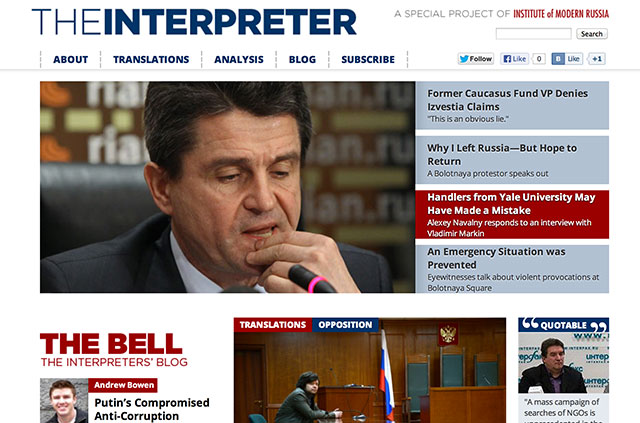
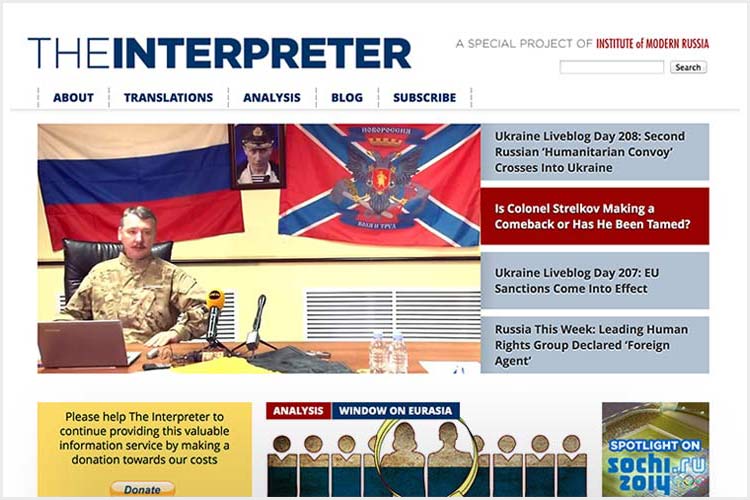
The Interpreter (interpretermag.com) was launched on May 1, 2013, by IMR and the Herzen Foundation. The project was immediately hailed as both well timed and long overdue. In its first year, The Interpreter has been read by hundreds of thousands of people from all over world—including journalists, human rights groups and policymakers—and its content has been cited by The New York Times, The Lost Angeles Times, The Guardian (where its work is syndicated as part of the Post-Soviet States network), Business Insider, The Atlantic, The Diplomat, Index on Censorship, Journal of Democracy, and Foreign Policy.
Since February 2014, The Interpreter has become an international “must-read” for breaking news on Ukraine; its reporting and analysis has been solicited by presidents, ambassadors, NATO and the U.S. State Department. Journalists have routinely turned to it as an invaluable resource for understanding a highly complex conflict. More than anything, The Interpreter has been credited with debunking Kremlin propaganda and disinformation about the Euromaidan protest movement; establishing Russia’s military operations in Crimea, and also breaking news pertaining to Russia’s ongoing yet still-denied warfare in east Ukraine.
Starting January 2016, The Interpreter is published by Radio Free Europe/Radio Liberty.
- Details
- Projects Archive
Public Outreach and Dialogue
- Details
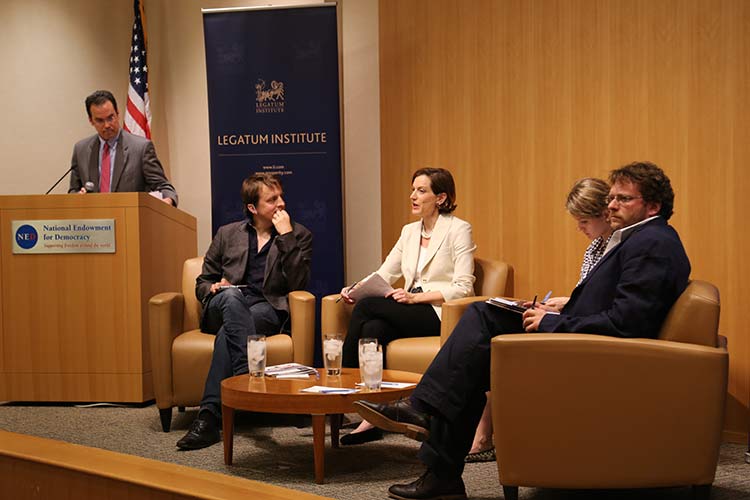
Contributing to the public dialogue is an important part of our work. Speaking directly to policymakers, political analysts, the media, and the general public helps generate ideas and stimulate debate on a number of crucial issues regarding Russia.
As part of this project, IMR organizes conferences, roundtables, public talks, and presentations in the United States and Europe. Since 2011, we have collaborated with numerous NGOs, think tanks, and academic institutions, including Freedom House, the National Endowment for Democracy, the Atlantic Council, the Legatum Institute, the Harriman Institute at Columbia University, and many more.
IMR has also partnered with some of these organizations to hold conferences on Capitol Hill and in European Parliament with a goal of bringing the West’s attention to human rights violations and political repressions in Putin’s Russia. Past speakers have included Sen. Ben Cardin; Rep. Jim McGovern; European Parliament members Guy Verhofstadt, Kristiina Ojuland, and Edward McMillan-Scott; Freedom House president at the time David Kramer; Lithuanian ambassador to the United States Žygimantas Pavilionis; Lantos Foundation president Katrina Lantos; Russian politicians Mikhail Kasyanov, leader of the People’s Republic Party, and Dmitry Gudkov, a State Duma member; and the slain opposition leader Boris Nemtsov.
- Details
- Projects Archive
The Innovative Approach to History Textbook
- Details
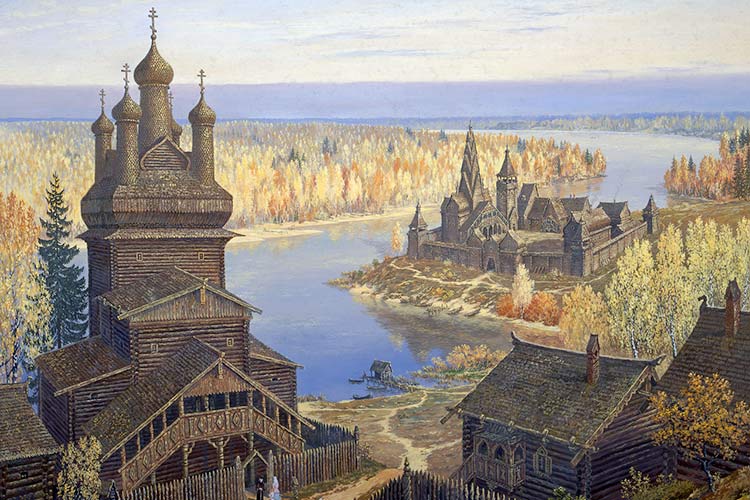
The complexities of facing Russia’s future require that we adopt new approaches to interpreting its past. Today, the return of neo-Stalinism and the conservative Soviet philosophy of history is visible in the Russian educational system and is manifested daily in both the country’s policies and the public consciousness. Together, the two strains of thought compose a powerful ideological machine that was formed over the course of 150 years, stemming from the writings of Nikolai Karamzin and developing through the introduction of Stalinist Marxism. At the heart of this ideology today is the notion that a sovereign ruler is necessary for a nation’s success. Subverting the dominant paradigm of Russian history remains a challenge.
Nevertheless, innovative approaches can be found in the New Imperial History project, an initiative created by a group of leading Russian historians. This project, sponsored by IMR, explores the myths of outdated historiography, recognizing the multiplicity of the past with a view to the pluralism of the future.
The project challenges the prevailing approach to Russian history and provides a realistic avenue for fostering change in Russian society. This collaboration of prominent Russian historians presents Russian history as a foundation for critical dialogue on complex situations, alternative historical developments, and factors that have contributed to various political, economic, and cultural outcomes.
In its final form, the collective project will become a textbook for college students, both Russian and English, featuring contemporary historical essays and discussions of the post-Soviet space.
- Details
- Projects Archive
Anticorruption Campaign
- Details
Corruption is without a doubt the most topical issue in Russia today, with destructive effects on the national economy and public institutions. The National Anticorruption Committee estimates the corruption market in Russia at around $300 billion a year, while human rights activists claim that corruption accounts for up to 50 percent of the country’s GDP. Transparency International ranks Russia 122nd of 177 countries in its 2013 Corruption Perceptions Index.
IMR seeks not only to expose the scale of the corruption, but also to make people think of the consequences of corruption practices. Most Russians have grown to believe that corruption is an inevitable evil, and even those who recognize its absurdity nonetheless cannot imagine their lives without it.
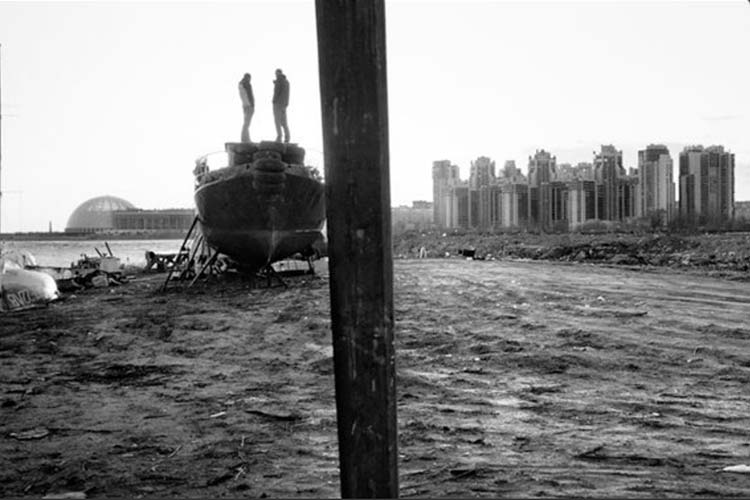
As part of its anticorruption efforts, IMR commissioned Photo 51: Is Corruption in Russia’s DNA? This project, which examines the deep, underlying roots of corruption in Russian society, consists of a series of photographs taken by Misha Friedman, a renowned New York photographer, in various parts of Russia. “Photo 51” was a nickname for the first X-ray diffraction image taken in 1952 that provided a breakthrough for researchers trying to model the structure of DNA. In today’s Russia, corruption has penetrated to the very core of society and, metaphorically speaking, has become a part of the country’s DNA.
In March 2013, the Photo 51 exhibition premiered in New York at the 287 Spring Gallery. In October, it was showcased at the Tallinn Portrait Gallery in Estonia as part of the Prison and Freedom exhibit dedicated to Mikhail Khodorkovsky. After that, the project was featured at the Mediaudar Festival in Moscow. Currently, IMR is working with the University of Michigan to showcase Misha Friedman’s exhibit in Ann Arbor’s Work Gallery in May 2015.
- Details
- Projects Archive
HIV/AIDS and TB Awareness Initiative
- Details
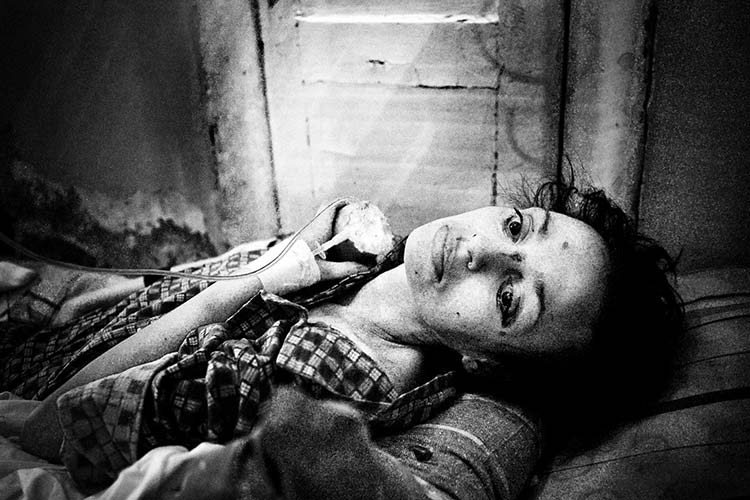
In 2011, IMR launched an initiative to raise awareness of the disastrous state of affairs regarding HIV/AIDS and tuberculosis in Russia. Russia has become a world leader in TB and currently, following India and China, has the largest number of multidrug-resistant TB cases. In most first-world nations, HIV/AIDS and TB have been taken under state control, have ceased to be taboo subjects, and have been destigmatized. This is not the case in Russia or the former Soviet republics, where independent observers report that the incidences of TB and HIV/AIDS have reached epidemic levels. But despite these grim figures, the authorities have not only ignored this problem but are actively suppressing information surrounding it. People are largely unaware that a significant proportion of Russians are TB carriers.
In the face of scarce information about the epidemic, New York–based photographer Misha Friedman has presented IMR with a valuable resource: a series of photographs taken beginning in 2008 that document the lives and inadequate treatment of HIV/AIDS and TB patients in the Caucasus, Uzbekistan, and Ukraine. In the autumn of 2011, with IMR’s support, Friedman expanded his project, visiting and photographing TB hospitals in St. Petersburg and Togliatti, Russia.
Over the course of 2012, IMR sponsored a series of exhibitions in the United States, the European Union, and Russia to showcase Friedman’s works and draw public attention to this acute social problem.
- Details
- Projects Archive
Political Art Show: Russian Visionaries
- Details
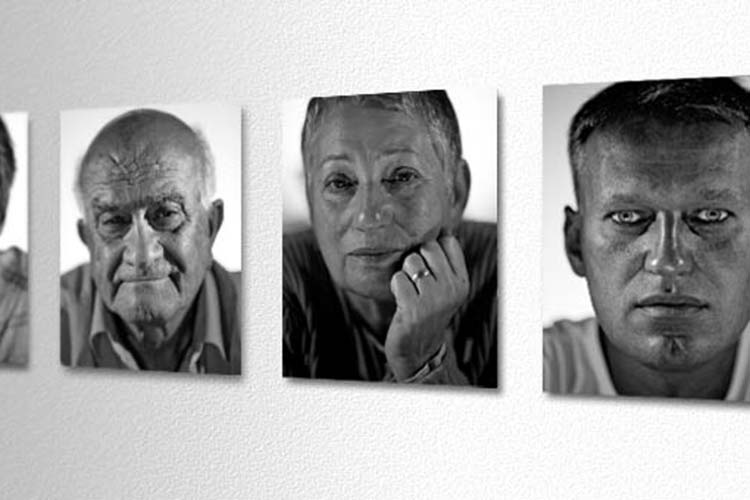
Russian Visionaries was a multimedia art project that displayed portraits of modern Russian thought leaders alongside their predictions for the future of Russia after the 2012 presidential election. The project was sponsored and developed by IMR and showcased in New York, Moscow, Berlin, and Paris in 2011 and 2012.
The central pieces of the project were the austere black and white photographs taken by Kirill Nikitenko, a well-known Moscow photographer. Among the 54 photographs were portraits of prominent Russian writers, actors, journalists, economists, politicians, and human rights activists known for their strong independent views and their opposition to the current regime. Their ranks included Boris Akunin, Alexei Navalny, Leonid Parfyonov, Sergei Parkhomenko, Lyudmila Ulitskaya, Yuri Shevchuk, Garry Kasparov, Yevgeny Yasin, Lyudmila Alekseeva, Lev Ponomarev, and many others.
All the participants shared their predictions of Russia’s future if Vladimir Putin remains in power. These predictions were presented alongside the portraits. Incidentally, the show coincided with the unprecedented mass opposition rallies that began in Russia in December 2011 and lasted through the winter and spring of 2012.
The original idea to bring together Russian intellectual leaders came from Elena Khodorkovskaya, the former wife of Mikhail Khodorkovsky, Russia’s most prominent political prisoner, who was finally released in December 2013.